
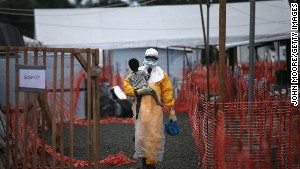
 After losing more than 4,000 people to Ebola, Liberia has now been declared free of the disease by the World Health Organization (WHO).
I
wish I were there to hug the wonderful people I met when I visited at
the height of the epidemic in September, when any contact, even shaking
hands, was forbidden.
Ebola 1 year later: Where they are now? 32 photos
It
was a horrible time. Ebola patients stood in line to get into hospitals
that didn't have a bed to spare. Thousands of children in West Africa
were orphaned. Burial teams roamed the streets carrying victims to crematoriums.
"We
went through just a horrific epidemic," said Dr. Thomas Frieden,
director of the U.S. Centers for Disease Control and Prevention, who
visited the country in August. "It's a searing memory that many of us
will carry with us for the rest of our lives."
Something
else is seared in my mind, too: the realization that smart people
failed to stop this epidemic before it got so terribly out of hand. The
outbreak started in March, and when I arrived six months later, the
response was still clumsy.
 Officials
in Monrovia, including ones from the WHO, held an elaborate opening
ceremony for an Ebola hospital, but then a few hours later when patients
arrived, no one came out to help them. Weakened by the virus, the patients fell out of ambulances onto the ground.
Officials
in Monrovia, including ones from the WHO, held an elaborate opening
ceremony for an Ebola hospital, but then a few hours later when patients
arrived, no one came out to help them. Weakened by the virus, the patients fell out of ambulances onto the ground.
A
doctor in a rural county begged authorities for an Ebola hospital, but
no help arrived. He was forced to build one himself, where he managed to
save many patients.
Dr. Gobee Logan worked around the clock to help fight Ebola in Bomi County, Liberia.
In
another part of Liberia, a woman couldn't find space in the hospital
for her four Ebola-stricken relatives and was forced to take care of
them at home by herself. She had no protective gear, and so suited up in trash bags to keep herself safe. Why was gear unavailable? It was just one of many unanswered questions during my time there.
Fatu
cared for four of her family members with Ebola, keeping three alive
without infecting herself. Her trash bag method was taught to others in
West Africa who couldn't get personal protective equipment.
 Larry
Gostin, faculty director of the O'Neill Institute for National &
Global Health Law at Georgetown University, gives the world an "F" for
the initial response to Ebola.
Larry
Gostin, faculty director of the O'Neill Institute for National &
Global Health Law at Georgetown University, gives the world an "F" for
the initial response to Ebola.
"If
the world had mobilized rapidly and decisively, we could have saved
10,000 lives, great human hardship, and enormous health and social costs
in three of the poorest countries in the world," he wrote CNN.
Three
reasons are often given for this poor initial response: Ebola hit big
cities, where people live in close quarters; the West African countries
have a dangerous lack of doctors, nurses, laboratories and supplies; and
it was difficult to convince people to put a halt to the tradition of
washing their dead relatives before burial, which spread the virus.
While all of those are true, there was something else going on.
Frieden
describes how back in March of last year, he tried to get his teams
into Guinea, where the outbreak started, but he says WHO leaders there
wouldn't let them in.
"We got all
these crazy questions, like 'We're not sure your team is qualified, send
us more CVs,' and 'We're not sure when would be a convenient time for
you to come,'" he said.
Frieden
Intervened, calling WHO officials in headquarters in Geneva. "That's
really unusual, for me, at my level, to have to call and say, 'Let my
staff in,'" he said. "There's been maybe one other instance where I had
to do that in my six years as director of the CDC."
In
July, the CDC was allowed to ramp up the response, sending 50 staffers
in just 10 days and 100 total by the end of the month.
"But our team was not particularly welcome there," he said. "It was not a very comfortable situation."
The
problem, he says, was that WHO leaders in Africa failed to appreciate
the severity of the outbreak and were overconfident they could handle it
on their own. "We were surging into the area and the WHO said, 'We
don't need you,'" he said.
As those
issues resolved in the late summer and fall, the CDC and others could
move in and do their jobs. Gostin gives this "late, belated response" an
"A."
It eventually worked. Liberia
has gone without a new case for 42 days, twice the maximum incubation
period, which is why it's now deemed free of Ebola.
"The road to zero has been long and hard," Frieden said.
Guinea
and Sierra Leone each had nine new cases last week, a dramatic decline
from last fall when each week saw hundreds of new cases.
There's
currently an internal and external review of the WHO Ebola response.
"What WHO did or did not do will be examined by this commission and the
results will be made publicly available for all to see," said WHO
spokesman Tarik Jasarevic. "In parallel, we are currently undergoing an
independent evaluation of our response chaired by Dame Barbara
Stocking."
And the organization is
already making reforms to respond more rapidly and effectively to public
health emergencies. "We have an extensive program of work to implement
these changes and will be reporting to the World Health Assembly later
this month," Jasarevic wrote CNN.
But Gostin is concerned WHO won't do enough.
"I
believe firmly that the world remains unprepared for the next
epidemic," he wrote to CNN. "The next epidemic, moreover, could be far
worse than Ebola, and we are not well prepared."
http://edition.cnn.com/2015/05/09/health/ebola-declared-dead-in-liberia/index.html

 About
About 


Show EmoticonHide Emoticon